
The Greatest Rescue Mission in Navy SEAL History
Saving Lieutenant Mark Clark and LTCOL “Gene” Hambleton, USAF
During 1972, U.S. Navy SEAL Lieutenant Tom Norris was serving as an advisor with Strategic Technical Directorate Assistance Team (STDAT) 158, which replaced the Special Operations Group (SOG) component of the Military Assistance Command, Vietnam (MACV-SOG). STADT 158 had responsibility for a variety of covert and clandestine operations, to include penetrating enemy territory to rescue downed American pilots. In the first week of April, Tom Norris was tasked with recovering two pilots shot down over enemy occupied territory in Quang Tri Province, the northern most province of South Vietnam (Adjacent to North Vietnam and the established Demilitarized Zone (DMZ).
The title of this story comes from the book “Saving Bravo” by Stephan Tally, which was published in 2018 and tells the story of the rescue missions. The first book published about this incredible story was entitled “The Rescue of BAT 21” by Darrel D. Whitcomb and published in 1998. BAT 21 was the call sign of the aircraft shot down in Quang Tri Province. BAT 21 Bravo was LTCOL Hambleton’s crew call sign.
There can be little argument today that this rescue was and remains the greatest rescue mission in Navy SEAL history. Primarily, because its success in the face of seemingly overwhelming odds; and, foremost, because it was carried out by only two selfless individuals under the most extreme operating conditions.
On 2 April, U.S. Air Force navigator Lieutenant Colonel Iceal “Gene” Hambleton was the only crewmember to safely eject after his EB-66 electronic surveillance aircraft was hit by a surface-to-air missile. He landed in the middle of 30,000 North Vietnam Army (NVA) soldiers that had swarmed south of the DMZ. They had already overrun and destroyed most of the South Vietnamese Army’s 3rd Infantry Division that had been formed to replace withdrawing American forces.

U.S. Air Force LTCOL Iceal “Gene” Hambleton.
All U.S. aircrews carried a survival radio that could operate in either beeper or voice mode, and Bat 21 Bravo’s beeper began transmitted a loud, piercing tone to relay that he had been shot down. On the ground, he listened for a sign that someone had heard his emergency signal. He soon established voice communication and notice that rescuers were on their way.
A USAF helicopter quickly flew in to rescue him and was as shot down. All crew members were killed or captured. The next day, USAF OV-10 pilots Lieutenants Mark Clark and William Henderson were shot down. Both safely ejected. Mark Clark hid in the south bank of the Mieu Giang River to wait for rescue; however, William Henderson was quickly captured. One USAF forward air controller, Captain Harold Icke, spent countless hours orbiting near LTCOL Hambleton and Lieutenant Clark.
For two more days, hundreds of airstrikes were called in to obviate NVA gunners to no avail. On 6 April, rescuers called in 42 air strikes to support another helicopter pickup. As the helicopter maneuvered to hover near LTCOL Hambleton’s position, it began to take heavy ground fire, broke apart, and crashed. The next day, another OV-10 was shot down.
By 9 April, the Air Force’s situation was austere. Eight USAF aircraft had been destroyed, 14 Americans were dead, two had been captured, and two were unaccounted for. For understandable reasons, the SAR task force was pulled out of the area and a ground mission was contrived. STADT 158 was assigned the task, which was led by U.S. Navy SEAL Tom Norris with four Vietnamese SEAL trained commandos. The concept of operation was to have Lieutenant Clark and LTCOL Hambleton move to the Song Mieu Giang River, where the STADT SEALs would float downstream for rescue.
The first attempt was on 10 April, during which Tom Norris spotted Lieutenant Clark at around 0200. But, with an enemy patrol between them, they had to let him float away. As dawn approached, they found him hiding on the riverbank and began working their way back through enemy territory. After coming under heavy NVA rocket and mortar fire, they managed to get Clark returned to safety.
On 12 April, Lieutenant Norris departed with Petty Officer Kiet Van Nguyen and three others, but they were afraid, and Tom Norris didn’t trust their competence to continue. Kiet volunteered to stay with him. “It was my duty,” Kiet later said. “Lieutenant Norris was the best of the best of Navy SEALs. I knew that Hambleton needed our help. And the rest of the Vietnamese commandos from my team were out [of the operation], which was a difficult situation for Tom. So, I volunteered to continue the rescue and told him that ‘If you work, I work. If you go home, I go home.’”
On 13 April, they moved up the Mieu Giang to a bombed-out village and found a usable sampan. They maneuvered silently upriver throughout the night, deep into enemy controlled territory, and past NVA positions and rumbling tanks. Heavy fog provided some concealment, but also made precise movement difficult. Once in the clear, they realized that they had overshot their objective area, and were directly under the Cam Lo bridge with NVA forces crossing over their heads.
Undetected, they reversed course and ultimately spotted LTCOL Hambleton hiding in bushes and lying in mud, but awake and partly delirious. Tom Norris radioed back to base that they had their prize. After getting LTCOL Hambleton into the sampan, they covered him with bamboo and began moving downriver. NVA troops discovered their movements and repeatedly took them under fire. Tom requested airstrikes. Fighter jets set up a low bombing pattern until all NVA positions near them were obliterated.
Tom Norris and Kiet continued on and maneuvered their sampan to the safety of their small base camp, where they carried LTCOL Hambleton ashore, gave him first aid, and called for an armored personnel carrier to evacuate them back to Dong Ha.
For their actions during these rescue operations, U.S. Navy SEAL Lieutenant Tom Norris was awarded the Medal of Honor, and Petty Officer Kiet Van Nguyen was awarded the U.S. Navy Cross Medal. Kiet was one of only two South Vietnamese servicemen to receive this award.
In the year 2000, a movie, “BAT-21,” was released. Astonishingly, the movie didn’t include any details surrounding the actions and activities of Tom Norris and Kiet.
Resources:
“The Rescue of BAT 21,” © 1998 by Darrell D. Whitcomb, Naval Institute Press, Annapolis, Maryland (ISBN 1-55750-946-8).
“Saving Bravo: The Greatest Rescue Mission in Navy SEAL History,” © 2018 by Stephan Talty, Houghton Miffin Harcourt Publishing Company, New York, NY (ISBN 9781328866721).
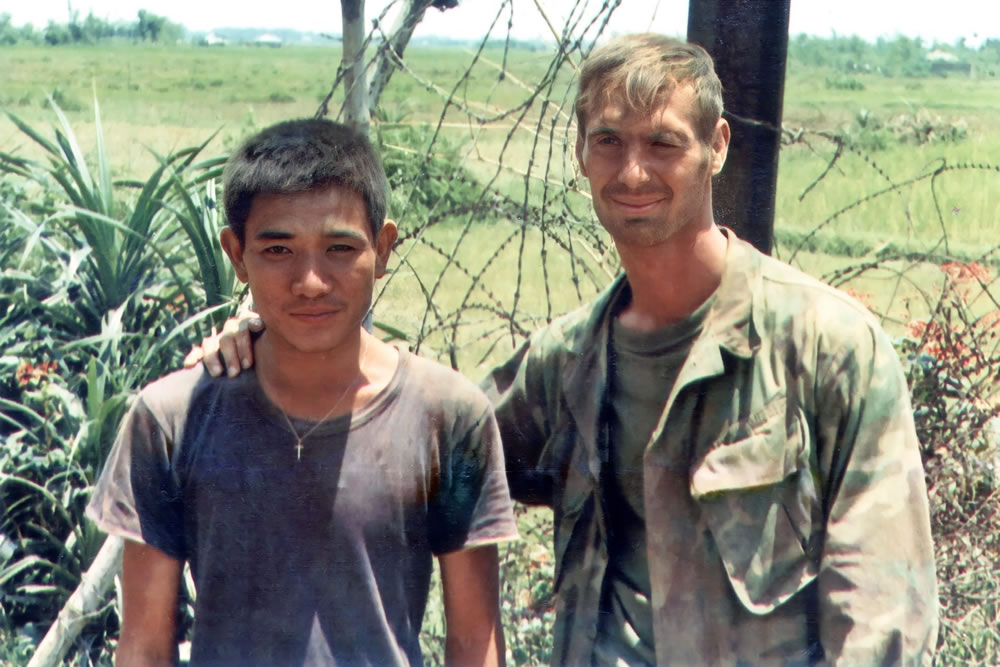
U.S. Navy SEAL Lieutenant Tom Norris and South Vietnamese SEAL Petty Officer Kiet Van Nguyen seen after their courageous rescue of U.S. Air Force LTCOL Iceal “Gene” Hambleton. (USN)
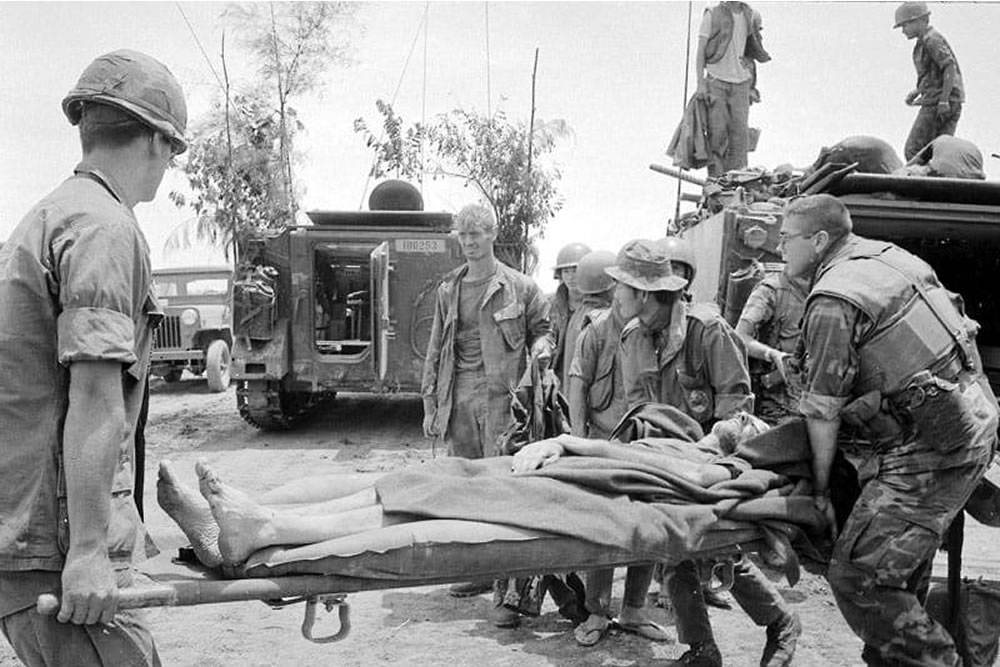
Navy SEAL Lieutenant Tom Norris observes as medical personnel carry LTCOL Hambleton to a waiting armored personnel carrier. (USAF)