
Japanese First Surrender to UDT Naked Warriors
World War II – 29 August 1945
On 10 August 1945, after President Truman gave the order to drop two atomic bombs on Japan, the Japanese openly sued for peace. On 15 August, UDT-18 and UDT-21 boarded C-54 transport planes to Guam and follow-on transport to Toyoko, where they joined the U.S. Third Fleet.
During ensuing operations on 29 August, UDT-21 had the rare privilege of being the first Navy personnel to land on the Japanese homeland. They made a quick reconnaissance for mines at the Toyoko harbor approach and continued reconnaissance at the Futtsu Saki shoreline. As Lieutenant Commander Edward P. Clayton, Commanding Officer of UDT-21 and his men approached Fort Number One, they saw a Japanese soldier standing erect on the beach.
Upon approach, they realized that this was a Japanese officer, whom they would soon discover was the commander of Fort Number One. As the men went ashore, the officer ceremoniously surrenders his Samurai sword to LCDR Clayton. With equal ceremony, LCDR Clayton accepted the sword, both as a token of surrender an as a priceless souvenir.
As could be expected, word leaked out, and LCDR Clayton was later required to give up the sword. As told by Commander Douglas “Red Dog” Fane in his book The Naked Warriors: “Nothing must mar the historic “first” of the surrender ceremony to General MacArthur aboard the USS Missouri. But history’s erasers often leave marks on the blackboard. UDT was there first – Samurai surrender to naked warrior!”
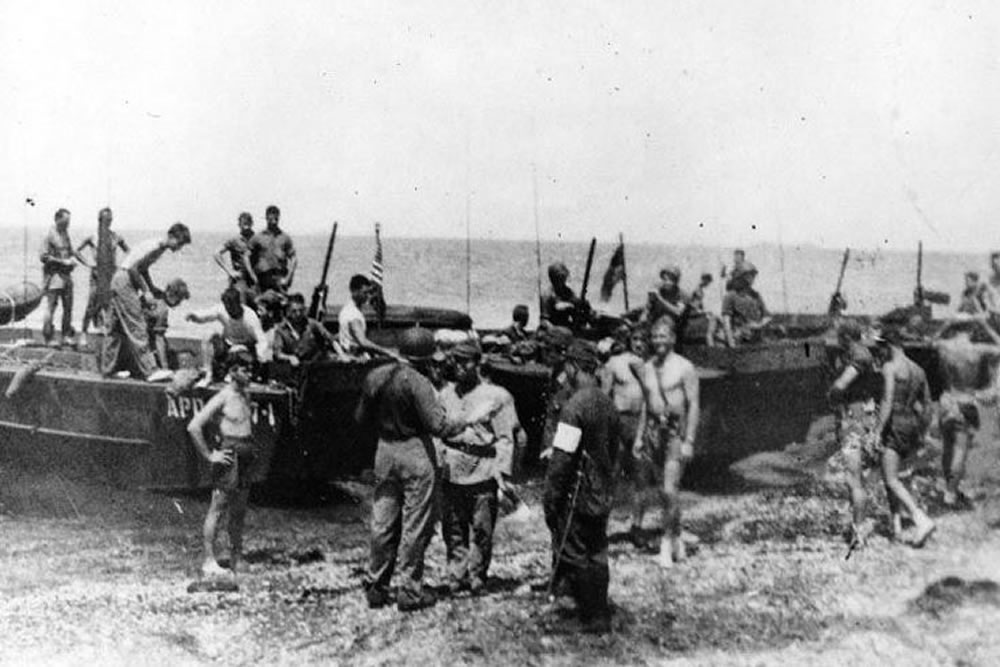
The Japanese commander of Tokyo Bay Fort Number One is seen surrendering his sword to UDT-21’s Commanding Officer, Lieutenant Commander Edward P. Clayton on 29 August 1945. This was the first, but not official, Japanese surrender to conclude hostilities during World War II.
Seen in the photograph to the left of LCDR Clayton include (l-r) in the first boat except as noted): Gunner’s Mate 2nd Class William P. Griffis; E.W. Pangburn; J.E. Paul; R. Rice; Seaman 1st Class A.L. Vadenburg (standing on beach in swim gear); Gunner’s Mate 1st Class Robert Lee Wicall (kneeling, in white shirt); Gunner’s Mate 2st Class Robert A. Winters (standing, behind Wicall); Seaman 1st Class Frank P. Goodwill (standing, beside Winters); Radio Technician 2nd Class L. Wurzel (kneeling, beside Wicall); Motor Machinist’s Mate 2nd Class O’Brien; Lieutenant (Junior Grade) Philip Masters (in white shirt, at bow of boat). Those standing to the right of LCDR Clayton (l-R), include: Motor Machinist’s Mate 1st Class Myron Earl Townsend (in second boat, only head and shoulders visible, just to right of Japanese Major); Coxswain Shirley Cox and Gunner’s Mate 1st Class E.G. Chesney (left to right, in swim gear, standing on beach just to right of group of Japanese in center).