
Pearl Harbor and the Underwater Demolition Teams
President Roosevelt spoke these words on 8 December 1941, the day after Japan’s surprise attack. The president asked Congress for a declaration of war against Japan, which was quickly and easily passed. Japan’s allies, Germany and Italy, then declared war on the United States on 11 December. The U.S. responded by also declaring war on Italy and Germany, officially entering the global conflict.
Events leading up to the attack resulted from escalating tensions between the U.S. and the Empire of Japan that were centered on Japan’s aggressive military expansionism in Asia. Japan’s goal was to dominate the region for resources, while the U.S. opposed this expansion and defended its economic interests and influence in the Pacific.
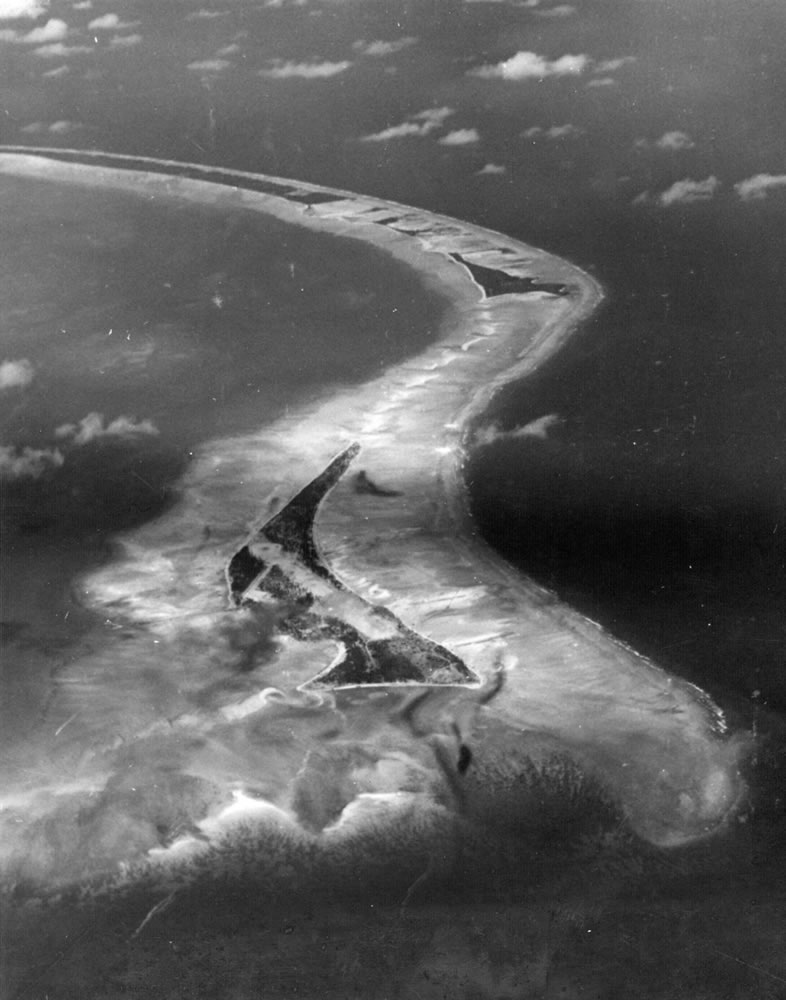
Following victory at Guadalcanal in early 1943, Allied forces began planning a new offensive across the central Pacific to advance toward Japan by moving from island to island, using each as a base for capturing the next. In November 1943, the first offensive attack happened with the Battle of Tarawa, a small atoll in the Central Pacific. Amphibious planners anticipated little to no resistance, but the Japanese were well prepared and well supplied with 4,500 troops.
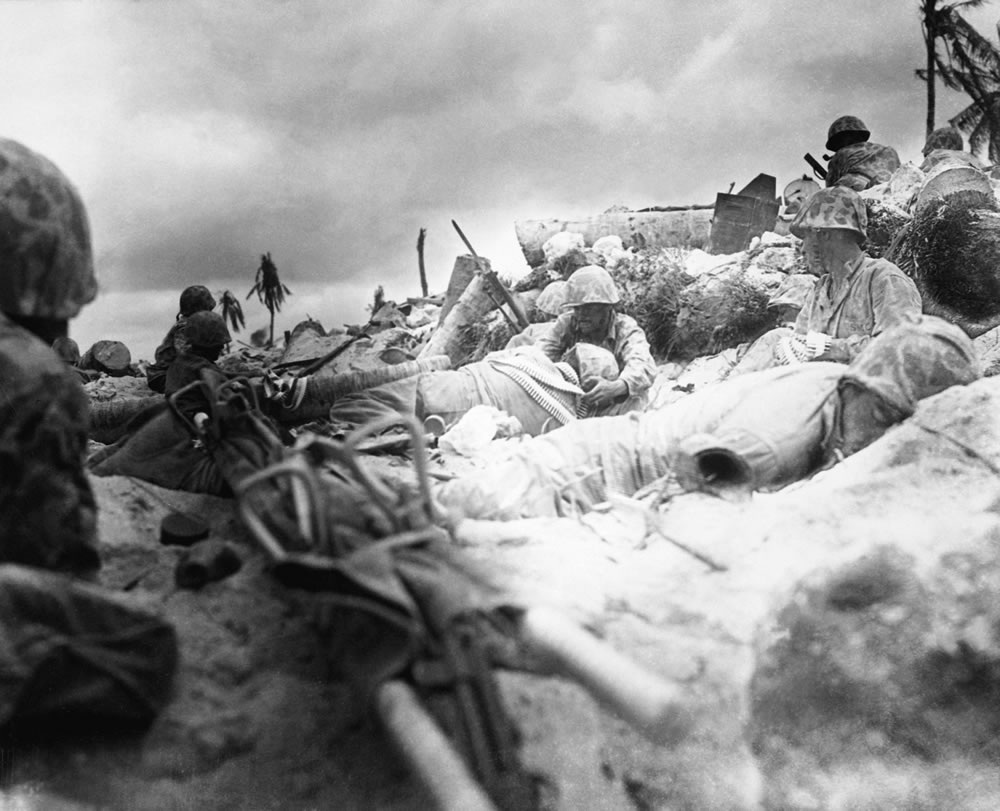
Intelligence planners believed the tide would be high enough to allow Navy landing craft to pass over them. During the assault on 20 November, however, many of these assault craft became stranded on the atoll’s reef and quickly came under attack from Japanese artillery and mortars. The embarked U.S. Marines were forced to enter the water and work their way towards shore while enduring heavy machine-gun fire. Encumbered with weapons and ammunition, many of the men drowned while attempting to get ashore. Others were shot before they could get to the beach. By the end of the first day, 5,000 Marines had landed, but 1,500 were killed in the process. “Bloody Tarawa” reinforced the fact that the Navy couldn’t depend entirely on aerial reconnaissance, and confirmed the need for pre-assault hydrographic reconnaissance to determine the prospect of natural and man-made obstacles. The need for Underwater Demolition Teams was already being considered; however, that need was now accelerated.
After the Tarawa experience, Admiral Richmond Kelley Turner, Commander of the 5th Amphibious Force, directed that 30 officers and 150 enlisted men be collected at the Amphibious Training Base (ATB), Waimanalo (now Bellows Air Force Station), in the Hawaiian Territory (H.T.) in early December 1943 to form the nucleus of a reconnaissance and demolition training program. The Waimanalo base was on Oahu directly across the island from Honolulu. Two UDTs were formed with volunteers from the U.S. Navy, Army, and Marine Corps. UDT-1 and UDT-2 were considered “provisional” UDTs with strength of 14 officers and 70 enlisted men each. They saw their first action on 31 January 1944 during the assaults on Kwajalein and Roy-Namur during Operation Flintlock in the Marshall Islands. Following Flintlock, these provisional UDTs were disestablished, however, the need for UDT capabilities was formally established, and a Naval Combat Demolition Training and Experimental Base was constructed adjacent to ATB, Kamaol on the island of Maui. Here, 28 additional UDTs were formed where these men trained and deployed between April 1944 and July 1945.
The attack on Pearl Harbor in December 1941 ultimately resulted in establishment of 30 Underwater Demolition Teams. Throughout the war, UDT men saw action across the Pacific in every major amphibious landing, including: Eniwetok, Saipan, Guam, Tinian, Angaur, Ulithi, Pelilui, Leyte, Lingayen Gulf, Zambales, Iwo Jima, Okinawa, Labuan, Brunei Bay, and Borneo. They became the most decorated Navy combat veterans of World War II. These men were awarded 750 Bronze Star Medals, 150 Silver Star Medals, two Navy Cross Medals, and an undetermined number of Purple Heart Medals – quite remarkable for the “Naked Warriors,” who went in to combat carrying no weapon other than a KA-Bar knife.

March 1943: These are the Navy men retained from provisional UDT-1 and UDT-2 after returning from the Marshall Islands. These men prepared the Naval Combat Demolition Training and Experimental Base on Maui during February and March 1944. Standing (l-r) CCM Jerome A. Schommer, SF2c J.W. Donahue, SK1c J.R. Reinhardt, Lieutenant William L. Hawks, Lieutenant William G. Carberry, Lieutenant Commander John T. Koehler (Commanded UDT-2) Lieutenant Thomas Christ, Lieutenant Lewis F.Luehrs, CCM R. B. McGinnis, SF1c W.O. Behne. Middle Row (l-r): GM2c E.W. Durden, GM3c Henry Green, F1c D.D.Fero, AOM1c C.W. Hoffman, UKN, S1c J.M. Brady, GM3c K.J. Rylands, SF1c R.L. Michaels, GM3c C.H. Brown, MM2c E. Fredericks, MM2c T.M. Lambert, GM3c B. Turner, SF1c James W. Conklin, S2c V. Gikey. Front Row (l-r): SF3c Robert E. Smith, GM3c Arthur Hall, EM3c L. Houk, CM2c VerdunAitkenhead, RM2c Edward Bigham, SM2c William D. Haithcock, F2c GordonCanizo, UKN, COX Burge Christensen, S1c Elmer L. Carlson, UKN, SC1John M. Bisaillon. The photograph is from the book “More Than Scuttlebutt,” (page 98) by Sue Ann Dunford and James Douglas O’Dell. The men were identified by Edward T. Bigham, Jr., who was a member of UDT-1. Rank and ratings were verified, and the spelling of names were corrected where possible. (This was an official U.S. Navy photograph provided to Sue Ann Dunford by Virgil Stewart)